
What a “second-order miss” is and why it matters on the SAT
Most SAT review treats a wrong answer as the endpoint: you got it wrong, so you review that exact problem, then move on. The “second-order miss” method treats a wrong answer as a signal. The visible mistake (the first-order miss) is what happened on the page. The second-order miss is the hidden skill that caused it—something you can improve once and then reuse across dozens of future questions.
This distinction matters because the SAT rewards transferable skills: reading precision, evidence tracking, algebraic structure, unit discipline, and process control under time. If you only fix the surface error, you risk repeating it in a different costume later. If you diagnose the second-order miss, you build a targeted fix plan that actually compounds.
The difference between first-order and second-order misses
First-order miss
The immediate reason you missed the question. Examples: “I misread ‘except’,” “I forgot to distribute the negative,” “I picked a choice that sounded right,” or “I ran out of time.”
Second-order miss
The underlying skill gap or breakdown that made that first-order error likely. Examples: weak negation awareness in reading, unreliable sign control, no evidence-check routine, or an inefficient time strategy for multi-step math.
Second-order misses are often uncomfortable because they point to a pattern, not a one-off. That’s also why they’re valuable: patterns are fixable.
A simple diagnostic workflow for every wrong answer
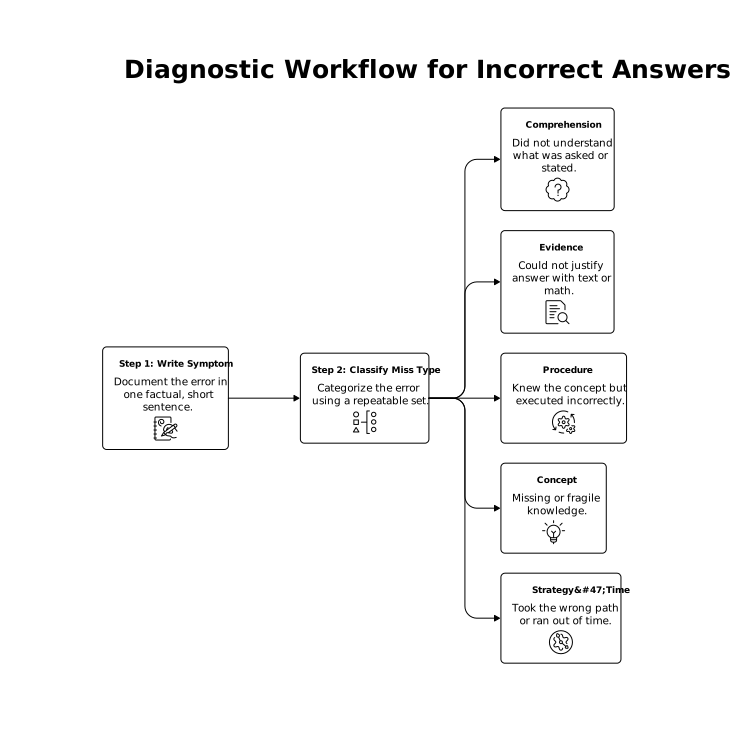
You can use this workflow on a paper notebook, a spreadsheet, or an app. The key is consistency.
Step 1: Write the “symptom” in one sentence
Keep it factual and short: “Chose B because it paraphrased the first sentence,” or “Solved for x but the question asked for x + 3.” This prevents vague labels like “careless.”
Step 2: Classify the miss type
Use a small set of repeatable categories so your data stays clean. A practical set looks like this:
- Comprehension (didn’t understand what was being asked or stated)
- Evidence (couldn’t justify an answer with text/math support)
- Procedure (knew the concept but executed incorrectly)
- Concept (missing or fragile knowledge)
- Strategy/Time (took the wrong path or ran out of time)
Step 3: Ask “what skill would prevent this next time?”
This is the core second-order question. If your answer is “be more careful,” you’re not done. “Careful” isn’t a skill; it’s an outcome. Replace it with a behavior you can practice.
Examples of second-order skills:
- Negation awareness: marking words like “not,” “except,” “least,” “cannot.”
- Answer-the-question discipline: circling the requested quantity and re-checking it at the end.
- Sign control: a repeatable check for negatives, subtraction, and inequality flips.
- Evidence tethering: forcing yourself to point to a line, phrase, or computed result that proves the choice.
- Setup before solve: translating once, then solving, instead of solving while translating.
Step 4: Create a “fix plan” with a minimum viable drill
A fix plan should be small enough to do the same day. The goal is not to “study the entire topic,” but to install a new habit and confirm it works.
Use a three-part template:
- Rule: one sentence you will apply next time (e.g., “Underline negation words and restate the question in positive terms.”).
- Drill: 6–10 targeted questions or micro-exercises that isolate the skill.
- Check: one explicit verification step (e.g., “Before selecting, point to the exact line that supports the claim.”).
Second-order miss examples for SAT Reading and Writing
Example 1: “I picked the most extreme answer”
First-order miss: Chose a choice with words like “always” or “completely.”
Second-order miss: Weak calibration for claim strength and author certainty.
Fix plan: Practice identifying hedging vs. absolute language. In review, rewrite each correct answer as a “strength level” score (e.g., mild, moderate, strong) and match it to what the passage actually commits to.
Example 2: “The grammar rule felt unfamiliar”
First-order miss: Missed a punctuation or clause boundary question.
Second-order miss: No reliable method for identifying independent vs. dependent clauses.
Fix plan: Drill clause labeling first (no punctuation decisions). Then add punctuation choices once clause ID is consistent.
Example 3: “I understood the passage but still missed it”
First-order miss: Answer seemed plausible but wasn’t text-anchored.
Second-order miss: Missing an evidence-check routine.
Fix plan: Implement a hard rule: don’t pick an answer until you can cite the specific phrase that proves it. If you can’t, it’s a guess wearing confidence.
Second-order miss examples for SAT Math
Example 1: “I solved correctly but answered the wrong thing”
First-order miss: Found x when the question asked for 2x or x + 5.
Second-order miss: Weak end-of-problem verification habit.
Fix plan: Add a 5-second finish step: re-read the last line and write the requested expression before selecting an answer.
Example 2: “Careless sign error”
First-order miss: Dropped a negative or distributed incorrectly.
Second-order miss: No standardized sign-control process under time pressure.
Fix plan: Use a two-check system: (1) box negatives before distributing, (2) do a quick plug-in check with a simple value (like 0 or 1) when possible.
Example 3: “I knew the concept but took too long”
First-order miss: Ran out of time after choosing a long algebra path.
Second-order miss: Limited strategy selection (not recognizing when to backsolve, plug in, or use a graphing approach).
Fix plan: For each slow problem, list two alternative approaches during review. This builds a strategy library so you’re not stuck with one tool.
How to turn diagnoses into a targeted weekly plan
Second-order misses only pay off if they shape what you do next. A practical approach is to run a weekly “miss audit”:
- Collect the last 30–50 questions you missed or felt unsure about.
- Group them by second-order skill (not by chapter name).
- Pick the top two skills that appear most often.
- Build two short drill blocks for the week (for example, 20–30 minutes each on two separate days).
This is similar to how product teams avoid fixing only the visible bug and instead address the underlying system cause. If you like that style of thinking, the idea overlaps with a negative demand audit: you’re not just counting misses, you’re finding the hidden reasons they keep happening.
Using adaptive practice to make second-order fixes stick
Once you’ve identified a second-order skill, you need enough repetitions to make the new behavior automatic. Adaptive practice is useful here because it can keep serving the right level of difficulty while you stabilize the skill.
For students who want the diagnosis-to-drill loop in one place, getsharp is built around targeted practice and explanations tied to specific weak spots. The most effective use is to treat each wrong answer as data: tag the second-order skill, do a small drill set, then re-test the same skill a few days later to confirm it held under time pressure.
When the “miss” is really a process issue—like evidence-checking or end-of-problem verification—write the new rule at the top of your next practice set. The SAT rewards consistent processes more than heroic one-time insights.