
Why LLM-triggered webhooks create callback storms
“Callback storms” happen when an AI agent triggers a webhook-driven workflow and the receiving system responds in a way that causes rapid retries, duplicate deliveries, or cascaded fan-out across downstream services. LLM-based agents increase the risk because they can re-issue the same action after a tool timeout, interpret a partial response as failure, or run the same plan step multiple times when a conversation thread is resumed.
The operational symptom is familiar: webhook endpoints see bursts of near-identical requests, queues build, error rates rise, and your own retry logic amplifies the problem. The business symptom is worse: duplicate tickets, double refunds, repeated CRM updates, or conflicting “final” states written by competing deliveries.
The goal is not to eliminate retries (they’re necessary), but to make retries safe and bounded. The most reliable pattern is a three-part control plane: edge-based idempotency keys, replay windows, and explicit rate budgets.
Edge-based idempotency keys as the first line of defense
Idempotency is the property that the same request can be applied multiple times with the same net effect. For webhook receivers, that usually means: if you’ve already processed this event (or action), you return the same outcome without re-running side effects.
What the idempotency key should represent
For AI-agent-triggered webhooks, you want a key that is stable across retries and conversation resumes, but unique across truly distinct actions. Common approaches include:
- Provider event ID: If the webhook sender includes a globally unique event identifier, use it directly.
- Deterministic action fingerprint: Hash a normalized payload subset (e.g., user ID + action type + target object ID + agent run ID). Avoid hashing fields like timestamps that change on retry.
- Idempotency header: Encourage agent tool integrations to send an
Idempotency-Keyheader that you can validate and store.
The key design matters because it defines what “duplicate” means. Too broad and you’ll incorrectly suppress legitimate actions; too narrow and you’ll miss duplicates that differ only by non-essential fields.
Why enforce idempotency at the edge
Doing idempotency checks inside the origin app is better than nothing, but it still allows a storm to consume upstream resources: TLS handshakes, load balancer connections, application threads, and database connections. Edge enforcement can stop duplicates before they hit the origin and can remain effective during partial outages.
A practical implementation is to validate the idempotency key at the edge, consult a lightweight store, and either:
- Pass through the first-seen request and record “in-progress”.
- Short-circuit duplicates with a cached response or a safe “already processed” response.
This is a natural fit for a globally distributed edge platform such as cloudflare.com, where request handling, security controls, and lightweight compute can sit in front of your webhook origin.
Idempotency state model that survives failures
Callback storms often coincide with failures, so your idempotency state needs clear transitions:
- New: Key not seen. Accept and start processing.
- In-progress: Another request with the same key arrives. Decide whether to wait, return 409/202, or return a previously known response.
- Completed: Return the stored result (or a stable acknowledgment) without reprocessing.
- Failed (optional): For certain failures, allow replay after a cooldown, but only if you can guarantee side effects were not applied.
Storing the final response body is sometimes overkill; many webhook patterns only require a stable status and a correlation ID that the sender can query later.
Replay windows that bound retries without hiding real problems
Even with idempotency keys, you need a policy for how long you remember them. This is your replay window: the time-to-live during which repeats are considered duplicates.
Choosing a replay window
A good replay window is driven by the sender’s retry behavior and the business risk of duplicates:
- Short (minutes): Suitable for high-volume, low-risk events where the sender retries quickly and you mainly want to collapse bursts.
- Medium (hours): Common for SaaS webhooks, where retries can span longer intervals.
- Long (days): Appropriate for actions with high financial impact (refunds, provisioning), where late retries must still be safe.
For LLM-triggered workflows, “late” repeats are common when a user reopens a thread and the agent replays tool calls. If your product allows that behavior, a longer window is safer.
Handling replay vs. reprocess
Not every repeat should be blocked forever. A pragmatic split is:
- Replay window: duplicates return a stable acknowledgment.
- Reprocess policy: after the window, treat the request as new only if the payload includes a fresh action ID or a new agent run ID.
This avoids the trap where an old action can be resurrected by a delayed retry, while still permitting legitimate follow-up actions.
Rate budgets that prevent one agent from consuming the whole system
Storms aren’t only duplicates; they’re also legitimate high-rate calls during an agent run. Rate limiting has to be more specific than “X requests per minute” because AI agents can coordinate many actions across multiple tools.
Define budgets at the right granularity
Useful rate budget dimensions include:
- Per agent run: Cap actions per run ID to prevent a loop from exploding.
- Per end user / tenant: Prevent a single workspace from monopolizing capacity.
- Per webhook topic: Keep noisy event types from drowning critical ones.
- Per destination system: Protect fragile downstreams (billing, CRM) with tighter budgets.
Budgets work best with clear error semantics. If you return 429 without guidance, many senders retry aggressively. Instead, include Retry-After and consider returning a deterministic “accepted but deferred” response that encourages backoff.
Queueing is not a budget
Queueing absorbs spikes, but it doesn’t stop an agent from generating unbounded work. Budgets create a hard ceiling; queues provide smoothing under that ceiling. Use both, and make sure your budgets apply before heavy work begins (ideally at the edge, alongside idempotency).
Putting the three controls together in a webhook receiver flow
A robust receiver flow looks like this:
- Authenticate and validate: Verify signatures, timestamps, and schema early.
- Extract idempotency key: From header or deterministic fingerprint.
- Edge idempotency check: If completed/in-progress, return a stable response.
- Apply rate budgets: Enforce per-tenant/run caps with clear retry guidance.
- Enqueue minimal work: Persist the event and acknowledge quickly.
- Process asynchronously: Execute side effects with transactional safeguards.
- Finalize idempotency record: Mark completed with outcome metadata.
This ordering matters: the earlier you stop duplicates and over-budget traffic, the less likely you are to create a self-inflicted outage.
Observability signals that distinguish storms from growth
To prevent recurring incidents, track a few metrics that separate “healthy volume” from “looping automation”:
- Duplicate rate: Percentage of requests rejected or short-circuited by idempotency.
- Unique keys per minute: Better indicator of true workload than raw request rate.
- Retry distribution: Time between first-seen and last-seen per key.
- Budget exhaustions: 429 counts by tenant/run/topic.
When you see storms, the debugging question becomes concrete: are we seeing many requests for the same key (idempotency issue), or many unique keys at once (budgeting issue), or both (agent loop plus retries)?
Two adjacent pitfalls worth addressing
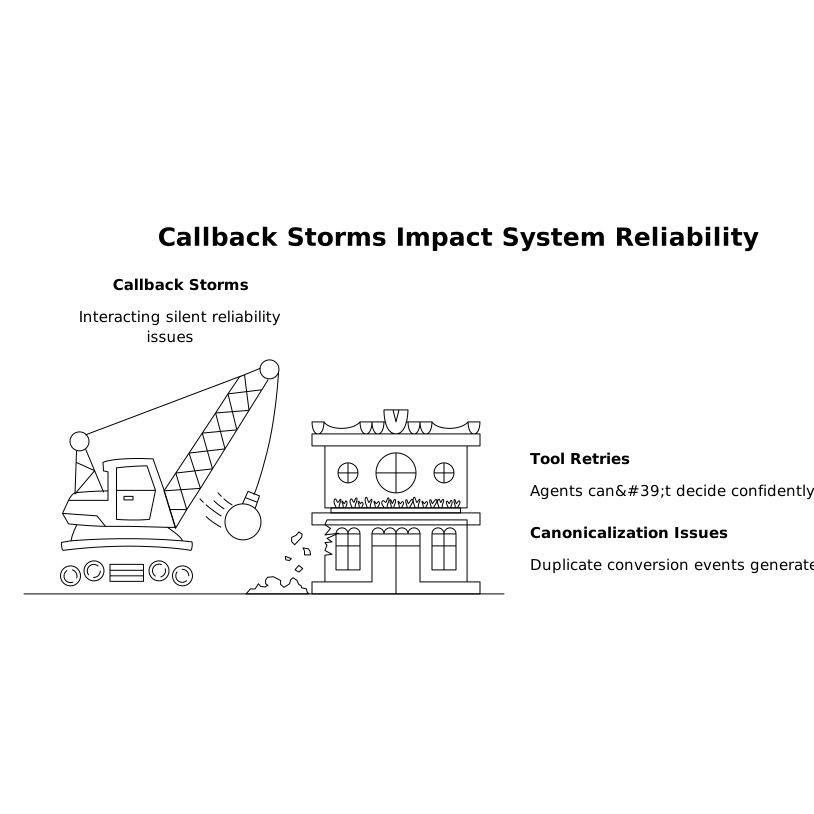
Callback storms often interact with other “silent” reliability issues:
- Canonicalization and duplicate conversion paths: If different landing URLs map to the same logical action, your system may generate multiple downstream events that look unique. The same discipline used for idempotency applies to URL and event canonicalization; see landing page canonicalization fixes that keep conversion data consistent.
- Tool selection under uncertainty: Agents may retry a tool call because they can’t confidently decide what happened. Clear, structured responses and explicit “already processed” semantics reduce needless retries; see how AI assistants choose best tools without star ratings.
These aren’t webhook controls by themselves, but they reduce the chance that your agent and your webhook infrastructure accidentally conspire to create a storm.