
Why refund negotiation breaks most “allowed actions” agent designs
Refunds, credits, and one-off exceptions look simple from a customer’s perspective. Internally they sit at the intersection of billing systems, CRM notes, entitlement rules, payment processors, tax handling, fraud signals, and support policy. Many agent designs start by enumerating what the agent is “allowed” to do: issue a partial refund, offer store credit, extend a trial, waive a fee, or escalate to a supervisor. That inventory is useful, but it rarely prevents the outcomes you actually care about: over-refunding, inconsistent precedent, policy drift across channels, or a customer receiving a promise that can’t be fulfilled in the ledger.
A constraint-first approach flips the framing. Instead of starting with actions, you start with the safe outcomes you must preserve (ledger correctness, policy compliance, risk caps, auditable approvals) and then design actions as constrained operators that can only move the system into permitted states. This is especially important for negotiation, where the agent must explore options and justify trade-offs while staying inside hard boundaries.
Define safe outcomes before you define tools
Safe outcomes are not slogans like “be compliant.” They are measurable invariants and bounded flex zones you can test. In refund and exception flows, the most common outcome constraints include:
- Financial caps: maximum refundable amount by SKU, plan, tenure, dispute status, or fraud tier; maximum credit exposure per account and per time window.
- Ledger alignment: every customer-facing promise maps to a concrete accounting event (refund, reversal, credit memo, invoice adjustment) with the right tax and currency handling.
- Policy precedence: the agent may offer exceptions only when an explicit exception policy applies, and must record the rationale category for future audits.
- Identity and authority: refunds only after verifying account ownership and payment method constraints; special handling for corporate accounts or delegated admins.
- Operational safety: no duplicate refunds, idempotent actions, and clear rollback/compensation steps when a downstream system fails.
These constraints form the “contract” for negotiation. The agent can still be helpful and flexible, but it negotiates within an explicit feasible set.
Model refunds as a constrained state machine, not a chat skill
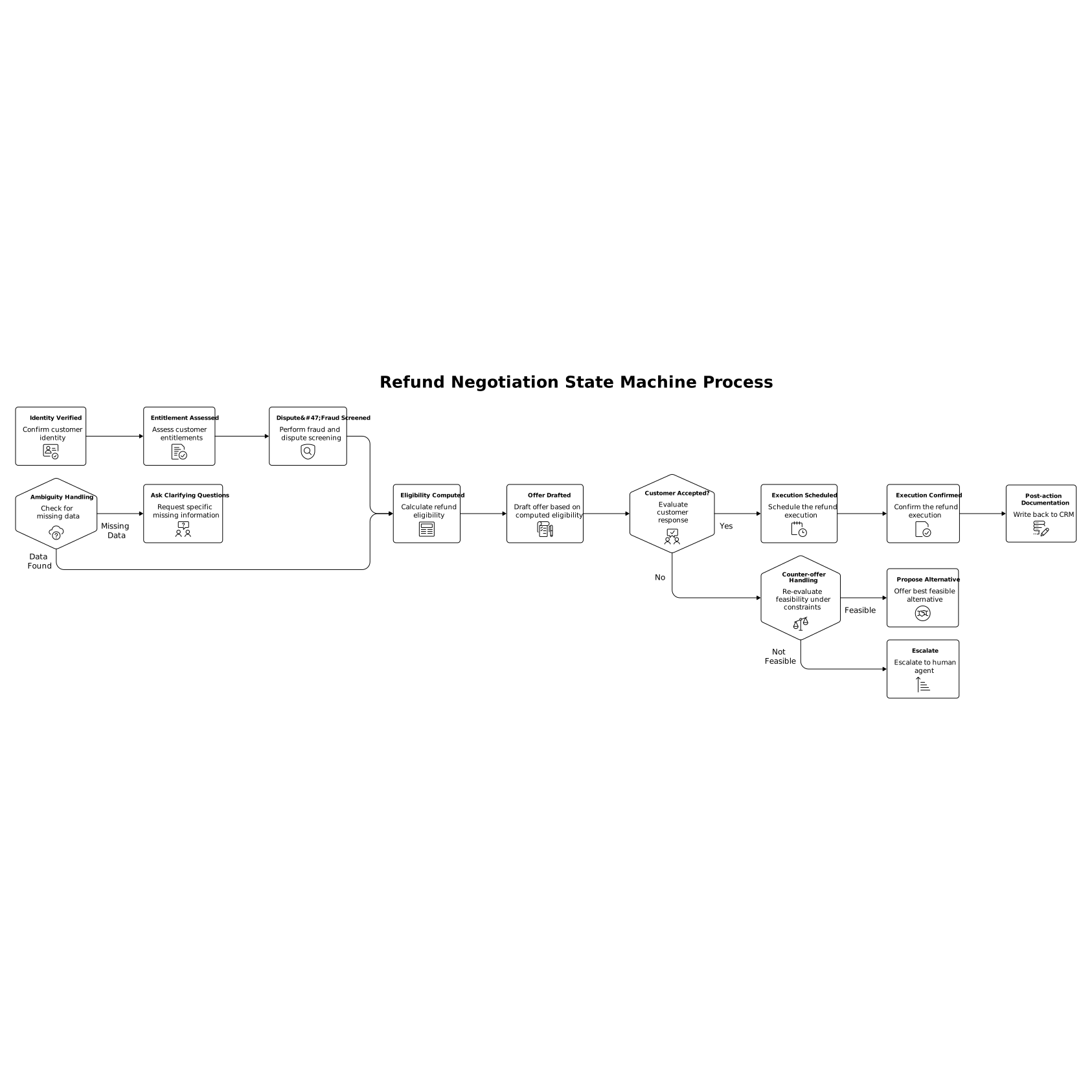
Negotiation across billing and CRM is a multi-system transaction with branching paths. Treat the workflow as a state machine whose transitions are guarded by constraints. Typical states might include: identity verified, entitlement assessed, dispute/fraud screened, eligibility computed, offer drafted, customer accepted, execution scheduled, execution confirmed, and post-action documentation written back to CRM.
The key move is making every transition conditional on structured checks rather than the model’s interpretation of policy text. If the agent drafts an offer, it should do so using computed eligibility (amount, refund type, timing) plus policy reasons, not free-form persuasion. If the customer counters, the agent re-evaluates feasibility under the same constraints and either proposes an alternative or escalates.
Guardrails that matter in negotiation
- Feasibility checks first: before the agent proposes “I can refund X,” it must verify the maximum refundable value and the method (refund vs credit vs invoice adjustment).
- Counter-offer handling: customer asks for more than allowed → agent responds with the best feasible alternative, plus a concise explanation anchored in policy and account facts.
- Ambiguity handling: missing data (e.g., charge not found, multiple subscriptions) → agent asks targeted clarifying questions, not generic probing.
Represent policy as constraints with explicit override paths
“Allowed actions” lists typically hide the real complexity: policy is conditional and contextual. Constraint-first design turns policy into a set of computable rules:
- Eligibility rules: window since charge, usage thresholds, contract terms, renewal status, prior refunds, chargeback flags.
- Offer rules: what types of remediation are permitted (refund to original method, credit balance, extension), how to compute amounts, and which reason codes apply.
- Override rules: what requires approval, who can approve, and what evidence must be attached.
The agent should treat overrides as a first-class path, not as a “break glass” improvisation. If a customer has a compelling case outside policy, the agent can request approval with a structured packet: account identifiers, timeline, computed policy outcome, proposed exception, risk flags, and the customer’s stated goal.
Tooling design: constrained operators and verifiable writes
Once constraints are clear, tools become safer to expose. Instead of a generic “refund()” tool, prefer narrow operators that take validated inputs and return authoritative receipts:
- ComputeEligibility: returns maximum refundable amount, permitted methods, required approvals, and rationale codes.
- CreateOfferDraft: creates a proposal object (not the final refund) with expiry, conditions, and reason code.
- ExecuteRemediation: performs the write only when the offer is accepted and all preconditions pass; returns transaction IDs.
- WriteCRMNote: logs the final outcome with structured fields and links to billing events.
This pattern helps avoid a common failure mode: the model hallucinating that something was processed. Every customer message about completion should be backed by a receipt from the billing system, and the agent should be forced to reference it.
Hybrid intelligence: approvals and partial handoffs that preserve momentum
Refund exceptions are exactly where human-in-the-loop works best: it’s not about distrust of the model, it’s about authority and accountability. The most effective pattern is partial handoff: the agent does the investigative work, prepares the recommended offer, and routes only the decision to an approver. After approval, the agent executes and communicates the outcome, keeping the customer experience coherent.
Platforms such as typewise.app are designed around this reality: connecting billing and CRM actions while keeping approvals, partial takeovers, and audit trails explicit. In practice, this is what turns “we have an agent” into “we can safely run refunds at scale across channels.”
Testing the agent means testing constraints, not prompts
Prompt quality matters, but negotiation safety comes from validating that constraints hold under adversarial and messy inputs. A practical evaluation suite should include:
- Edge-case simulations: duplicate charges, proration, multiple currencies, tax-inclusive invoices, gift subscriptions, corporate contracts.
- Adversarial negotiation: customer insists on an amount above cap, threatens chargeback, or cites a past precedent.
- System failure modes: billing API timeouts, partial execution, stale CRM data.
- Regression tests on policy changes: verify that updated refund windows or credit limits do not silently expand exposure.
This is also where teams often discover they need better coverage of real customer feedback segments to avoid optimizing only for the loudest cases; a structured approach like a feedback coverage map can reveal silent cohorts and their typical refund drivers.
Operationalizing negotiation across channels without policy drift
Refund negotiation happens in email threads, web chat, and messaging channels where context is fragmented. Constraint-first design reduces drift by forcing the same eligibility computation and the same offer objects regardless of channel. The conversational layer adapts tone and brevity, but the decision core is identical.
Two implementation details prevent subtle inconsistency:
- Single source of truth for customer state: unify identifiers and make every step reference the same subscription, invoice, and payment entities.
- Unified supervision: route high-risk or high-value cases through a supervisor policy that can trigger extra verification or mandatory approval.
If you’re building multi-agent systems, it helps to understand how assistants select tools when ratings don’t exist; tool choice should be policy-driven and observable, not an opaque model preference. For measurement, teams deploying agents into new AI-driven traffic sources also benefit from instrumenting non-cookie signals to track performance across AI discovery and support entry points.
Where to start: a minimal constraint-first blueprint
- List invariants: caps, audit requirements, identity checks, and ledger correctness rules.
- Convert policy to computable eligibility: produce a deterministic eligibility object for each case.
- Design constrained tools: draft offers first, execute only on acceptance and validated preconditions.
- Add explicit override paths: approvals with structured packets and reason codes.
- Evaluate with negotiation scenarios: ensure constraints hold under pressure, ambiguity, and system failures.
This method doesn’t reduce negotiation to rigidity. It gives the agent room to be persuasive and empathetic while making it difficult to create unsafe financial or compliance outcomes—exactly what refund, credit, and exception workflows demand.
how assistants choose best tools becomes a concrete engineering question when tool choice has financial consequences, and a feedback source coverage map helps ensure your negotiation policies reflect the full customer base.