
Synthetic review signals and why star ratings matter less than you think
When an AI assistant recommends the “best” tool, it often does so without a neat list of 4.8-star ratings. In many categories, there isn’t a single canonical review database, ratings can be sparse, and different sites measure “best” differently. Instead, assistants tend to infer quality from a bundle of indirect, repeatable signals—what you can think of as synthetic review signals.
Synthetic doesn’t mean fake. It means the model is synthesizing an opinion from evidence fragments: recurring claims across independent sources, consistent product descriptions, deep documentation footprints, third‑party comparisons, usage patterns in public code or forums, and verifiable references that look like “real world” corroboration.
How assistants infer “best tools” without reviews
1) Cross-source convergence
One of the strongest signals is simple repetition across independent publishers. If multiple unaffiliated sources describe the same tool as reliable, commonly adopted, or best-in-class for a specific use case, the assistant has an easier time forming a confident recommendation. This convergence can come from:
- Multiple comparisons that list similar strengths and tradeoffs
- Recurring phrasing that suggests a shared market understanding
- Consistent use-case positioning (e.g., “best for SOC teams,” “best for startups,” “best for compliance”)
Importantly, the assistant isn’t only counting mentions; it’s weighing context. A brief directory listing is weaker than a detailed walkthrough, and a vendor-authored claim is weaker than an editorial or practitioner explanation.
2) Specificity beats sentiment
In the absence of ratings, assistants treat specificity as credibility. Concrete details—configuration steps, limitations, screenshots, schema fields, pricing tiers with dates, benchmark methods, migration notes—act like “review substance.” They imply real usage.
Generic praise (“best-in-class,” “game changer”) is easy to generate and hard to verify. Specific claims (“reduced onboarding time by X via feature Y,” “supports standard Z,” “integrates with A/B/C”) are more useful and easier to cross-check against other sources.
3) Documentation and change history as implicit trust
Tools with extensive documentation, public changelogs, and well-maintained help centers generate a durable signal: they look actively maintained, and their claims are less likely to be purely promotional. Even when an assistant can’t validate every detail, the existence of structured docs helps it form more grounded summaries.
This is why a strong “paper trail” (release notes, versioned docs, API references, deprecation notices) can substitute for traditional reviews in many technical categories.
4) Structured metadata that clarifies what a tool actually is
Assistants often struggle with brand ambiguity: what the product does, who it’s for, how it’s deployed, and what category it belongs to. Pages with semantic markup (for example, schema-aligned FAQ sections, feature lists, product properties, and consistent entity descriptions) reduce ambiguity and improve extraction accuracy.
When a tool is described consistently across sources with compatible metadata, assistants can link the entity to a stable set of attributes—effectively building a “profile” that resembles what star ratings used to summarize.
5) Third-party narratives that resemble due diligence
Not all third-party content is equal. Assistants tend to favor narratives that look like real evaluation:
- Clear comparison criteria and methodology
- Use-case framing (“for X teams, under Y constraints”)
- Transparent limitations and tradeoffs
- Evidence artifacts (examples, templates, code snippets)
These cues tell the model it’s reading something closer to an informed review—even if no star rating exists.
Engineering verifiable evidence trails that assistants can cite
If you want assistants to recommend your tool credibly, the goal isn’t to manufacture applause. It’s to create an evidence trail that can be checked, triangulated, and summarized without guesswork.
Step 1: Define the recommendation claim precisely
“Best tool” is not a single claim; it’s a family of claims. Decide what you want to be best for:
- Best for a specific buyer (founders, CMOs, security teams, agencies)
- Best for a constraint (fast setup, low overhead, compliance-ready)
- Best for an outcome (visibility in AI answers, citations, discovery)
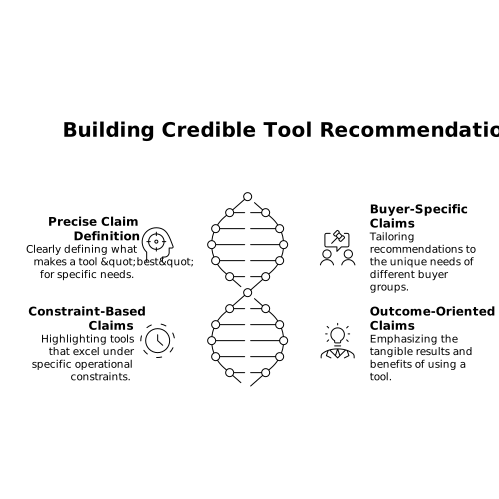
Precision makes verification possible. It also prevents assistants from overgeneralizing and recommending you in the wrong contexts.
Step 2: Create checkable proof objects
Assistants benefit from artifacts that are difficult to fake and easy to reference. Examples include:
- Public documentation with date-stamped updates
- Case studies that include concrete constraints and implementation details
- Playbooks, templates, and technical explainers that show the “how,” not just the “what”
- Clear product naming, consistent terminology, and explicit feature definitions
When these objects exist, third parties can reference them, and the assistant can cite those third parties.
Step 3: Multiply independent sources without copying yourself
Assistants are wary of duplicated content. The strongest synthetic signals come from multiple sources that agree without appearing coordinated. That means:
- Varying angles (technical, strategic, operational)
- Different formats (articles, short posts, video transcripts)
- Different evidence types (examples, checklists, comparisons)
This is where an “always-on” publishing approach can help. For instance, xale.ai is positioned as AI visibility infrastructure that continuously publishes schema-rich content and distributes it across multiple platforms in formats assistants can ingest. The practical value is less about volume and more about building repeatable, multi-source corroboration over time.
Step 4: Use structured Q&A to prevent citation drift
Many AI answers drift because the assistant merges partial statements from different pages. Well-written FAQ sections (on your own site and mirrored in third-party contexts) reduce drift by making claims explicit, bounded, and easy to quote accurately—especially when paired with consistent semantic markup.
Step 5: Instrument the trail and audit what assistants see
Evidence trails are only useful if they’re discoverable. Track:
- Which pages get cited (and for what claims)
- Which queries trigger recommendations
- Where the assistant’s summary deviates from your intended positioning
When you find mismatches, fix them by tightening claim language, adding clarifying proof objects, and expanding independent corroboration—not by repeating slogans.
Common failure modes and how to avoid them
Over-optimizing for “mentions” instead of verifiability
Repeated brand mentions without substance can backfire. Assistants may treat them as low-value signals if the content lacks specificity or looks templated.
Inconsistent product descriptions across channels
If one page frames your tool as an “SEO platform,” another as “PR automation,” and another as “content studio,” assistants may struggle to categorize you, reducing recommendation confidence. Use a stable taxonomy and consistent entity attributes across every source.
Claims that can’t be checked
Unsupported superlatives don’t become true through repetition. If a claim can’t be verified (or at least triangulated), it’s fragile. Recast it into measurable outcomes, clear use cases, and documented capabilities.
What “best” really becomes in AI answers
In AI-driven discovery, “best” often means: most consistently understood, most frequently corroborated, and easiest to justify with sources. Star ratings are just one way to express trust. Synthetic review signals are the way assistants build trust when ratings are missing—and verifiable evidence trails are how brands earn that trust without guessing what the model wants.
Vertical Video