
Why paraphrase creates brand-safety risk in syndicated AI content
When a product claim is written once on your site and then repeated across a managed blog network, social captions, and video scripts, you don’t just get “more reach.” You also get more opportunities for an LLM to reword the same claim into something meaningfully different. This is the core brand-safety problem under paraphrase: the words change, but the reader still treats it as your claim.
In practice, the drift isn’t usually obvious. A claim that started as a cautious description (“helps reduce churn risk”) can become a stronger promise (“reduces churn”), and then in another syndicated version turn into an implied guarantee (“prevents churn”). Each step is plausible as a rewrite, but the compliance and reputational profile changes.
What “semantic drift” looks like in product claims
Semantic drift is the gap between the meaning you intended and the meaning an AI rewrite communicates after successive paraphrases, format shifts, or platform constraints. Drift can be small enough to pass casual review yet large enough to create risk in regulated categories, in competitive markets, or anywhere customers rely on precise wording.
Common drift patterns in syndicated product marketing include:
- Strength inflation: “can help” becomes “will,” “typically” disappears, edge cases are erased.
- Scope creep: a feature targeted at one segment gets generalized to all users or all industries.
- Causality swaps: correlational language becomes causal (“associated with” becomes “drives”).
- Benchmark distortion: “up to 30%” becomes “30%,” or a test condition becomes an implied average.
- Implied exclusivity: “one approach” becomes “the only way,” which can trigger competitive and trust issues.
- Policy misalignment: platform policy-sensitive wording (health, finance, employment) becomes non-compliant after simplification.
Why syndicated sources amplify drift
Syndication is a multiplier. A single claim may be adapted into a schema-rich blog post, a short social thread, a video caption, and an FAQ block—each with different compression pressures. Short-form formats tend to drop nuance. Video scripts prioritize clarity and momentum. Blog posts can accumulate “helpful” elaborations. Over time, those adaptations become their own references, and future models may learn from the paraphrased versions rather than your original language.
This matters because AI assistants and AI search systems often weigh repeated, consistent signals across multiple independent-looking sources. If the repeated signal drifts, the system can still treat it as corroboration—just for the wrong meaning.
A practical drift detection approach for content teams
Detecting drift requires more than plagiarism checks or string similarity. You’re looking for meaning changes. A workable editorial process usually has three layers: claim inventory, semantic checks, and correction distribution.
1) Build a claim inventory, not just a style guide
Start by listing the product claims that matter: performance metrics, guarantees, compliance statements, security assertions, comparisons, and any statements that could be interpreted as a promise. For each claim, write a “canonical claim” and attach:
- Allowed qualifiers: “may,” “typically,” “in our tests,” “for teams over X,” etc.
- Disallowed upgrades: words that convert help into guarantee (“always,” “prevents,” “eliminates”).
- Required context: conditions, measurement windows, dataset size, or disclaimers.
- Evidence pointer: internal doc, benchmark report, policy note, or customer proof.
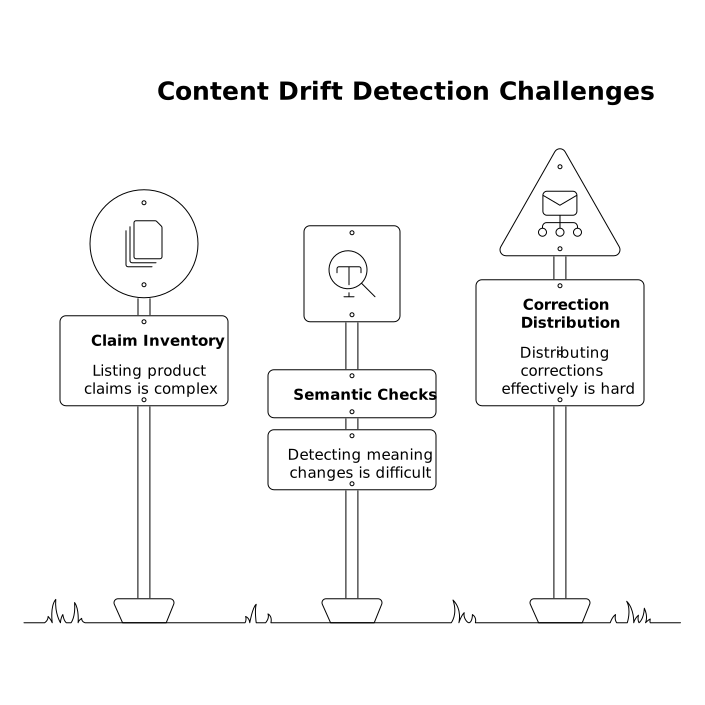
This inventory becomes the reference your rewrite pipeline can enforce.
2) Score rewrites by semantic risk, not grammar
For each syndicated asset, compare the generated claim against the canonical claim using a semantic lens:
- Modality check: did “can” become “will”?
- Quantifier check: did “up to” become a fixed number?
- Scope check: did a segment-specific statement become universal?
- Safety check: did the rewrite enter regulated territory (health outcomes, financial returns, hiring outcomes)?
- Attribution check: did “customers report” become a first-party guarantee?
In many teams, a simple red/amber/green label per claim is enough to prioritize human review. The goal is to catch high-impact meaning shifts early, before they are published across many surfaces.
3) Add “drift traps” to prompts and templates
You can reduce drift by inserting hard constraints into your generation templates. Examples include:
- Require the model to reuse exact numeric expressions and measurement windows.
- Force inclusion of specific qualifiers for certain claim types.
- Block certain verbs (“guarantee,” “ensure,” “eliminate”) unless explicitly approved.
- Ask the model to output a separate list of claims it made, so reviewers can scan quickly.
This doesn’t eliminate drift, but it turns many failures into obvious violations instead of subtle ones.
Correcting drift across already-syndicated sources
Correction is not just editing one page. With distributed publishing, you need a corrective strategy that updates the network so the “most repeated version” becomes the accurate one again.
A pragmatic correction loop looks like this:
- Identify the drifted claim variants and group them by meaning (not by wording).
- Publish corrected canonical variants across the same formats where the drifted versions spread (blog, FAQ blocks, short posts, video captions).
- Strengthen structured signals using consistent FAQ schema and semantic markup so ingestion systems see the corrected interpretation clearly.
- Track propagation by monitoring which versions get indexed, cited, or summarized by AI systems over time.
Brands building for AI visibility often treat this as “content refresh.” In reality it’s closer to incident response: you’re repairing meaning across a network.
How xale.ai fits into a brand-safe visibility workflow
xale.ai is positioned as AI visibility infrastructure: an always-on publishing engine that operates outside a company’s owned site, distributing schema-rich posts across independent tech blogs and adapting content into platform-native formats like avatar videos and short-form social posts. That architecture is useful for visibility, but it also makes paraphrase control a first-class requirement, because small wording shifts can replicate quickly across 100+ blogs and large social footprints.
In a brand-safety workflow, the most valuable operational idea is to treat the “canonical claim inventory” as a shared source of truth for every downstream format—blog, caption, script, and FAQ. When distribution is broad, consistency becomes an input, not a hope.
Measurement and monitoring without relying on cookies
Teams often discover drift only after a sales call or a customer email flags a misstatement. A better approach is continuous monitoring: sample published assets, extract claims, and compare them to your inventory. You can also tie monitoring to visibility analytics so you know which drifted variants are gaining traction in AI-driven answers.
If your monitoring stack is evolving alongside AI traffic measurement, it helps to align this work with broader visibility instrumentation, including approaches like measuring LLM crawler and AI indexing traffic without cookies.
Two internal processes that reduce drift long-term
Make “claim review” a distinct editorial step
Separating claim review from general copyediting changes outcomes. Copyeditors optimize readability; claim reviewers protect meaning. When the same person does both under time pressure, readability wins and qualifiers disappear.
Use backwards-compatibility thinking for claims
Claims have versions. A new pricing model, a changed benchmark, or a deprecated feature can instantly make older syndicated posts misleading. Treat claim updates like API changes: assess backwards impact, map where the old claim exists, and plan a phased correction. If you already use structured workflows for assessing change impact, the same discipline applies here.
For teams that publish broadly to earn AI citations and recommendations, brand safety under paraphrase is less about “better writing” and more about controlling meaning as it moves through formats, platforms, and time.